Customer Relationship Management Course
24-hour program led by industry practitioners
KHDA-licensed training from a trusted institute
Hands-on CRM simulation & Automation Sandbox exercises
Friction Method that turns learning into performance
Flexible & convenient payment options

 4.5/5
4.5/53671 EnrolledEnrolled Learners
4.5/53671 EnrolledEnrolled Learners
Overview
What our training includes:
- Covers B2B, B2C, and internal-external customer relationship management
- Explains customer perception points and changing service expectations
- Teaches structured approaches to complaints and service recovery
- Introduces Customer Lifetime Value and CRM measurement dashboards
- Uses Industry Simulation and Automation Sandbox for practice
- Applies customer feedback to strengthen long-term loyalty strategies
Upcoming sessions
Curriculum
1
The key role of the Customer Relationship Manager (CRM) in developing a competitive edge
2
Differences between Business-To-Business (B2B) Customer Relationship Management and Business-To-Consumer (B2C) Customer Relationship Management
3
Identifying barriers to providing exceptional customer service
4
Understanding why the happy Internal Customer is more motivated to provide exceptional External Customer service
5
Identifying the Perception Points of the organization
6
Understanding customers’ changing needs

Activities/Case Study
- A customer-facing organization analyses its B2B and B2C relationships, identifies internal service barriers and evaluates how employee experience influences external customer service
1
Detailed analysis of organizational Perception Points
2
Key steps of Customer Service
3
Calculating Customer Lifetime Value (CLV)
4
Understanding different Customer Feedback Mechanisms
5
Creating a CRM dashboard – “What Gets Measured Can Be Improved!”
6
Changing times and the impact of technology on CRM
7
Understanding and responding to customers’ changing needs
Activities/Case Study
- An organization experiencing declining customer satisfaction analyses its Perception Points, customer feedback and Customer Lifetime Value to identify measurable service improvements
1
Dealing with queries, questions and complaints
2
Handling unreasonable requests effectively
3
Creating an exceptional service recovery mechanism for enhancing customer retention
4
Applying customer feedback to improve service recovery
5
Identifying opportunities to strengthen customer relationships following service failures
Activities/Case Study
- A key customer raises repeated complaints following a service failure and makes an unreasonable request, requiring the service team to manage the interaction and develop an appropriate recovery mechanism
1
Using Customer Feedback to innovate and “Stay Ahead of the Competition”
2
Best practices in CRM
3
Learning from highly relevant case studies
4
Creating Long-Term Loyal Customers
5
Connecting customer feedback, service quality, service recovery and retention
6
Applying CRM practices to strengthen long-term customer relationships
Activities/Case Study
- An organization experiencing declining repeat business uses customer feedback, CRM best practices and service-recovery insights to develop a strategy for creating long-term loyal customers
The Customer Relationship & Service Excellence Simulation places participants in a realistic customer-facing business environment where they must manage different customer interactions across the relationship lifecycle. Participants analyse customer expectations, identify perception points, respond to queries and complaints, distinguish between reasonable and unreasonable requests, and determine appropriate service responses for both internal and external customers.
The simulation progresses into a service recovery and retention challenge in which participants use customer feedback, relationship information and CRM metrics to identify the causes of customer dissatisfaction and recommend improvements. The final challenge requires participants to balance service quality, customer expectations, relationship value and long-term retention while applying practical CRM principles.
The CRM Measurement & Customer Insight Sandbox provides a controlled environment for participants to work with realistic customer relationship information, feedback records and service-performance data. Participants explore how CRM information can be organized and interpreted to identify customer trends, service barriers, perception points and opportunities for improvement.
The sandbox also introduces the practical use of CRM dashboards and measurement frameworks to connect customer activity with service outcomes. Participants analyse customer feedback and relationship indicators to identify improvement opportunities, evaluate customer value and support decisions aimed at strengthening customer retention and long-term loyalty.
Meet your Trainer
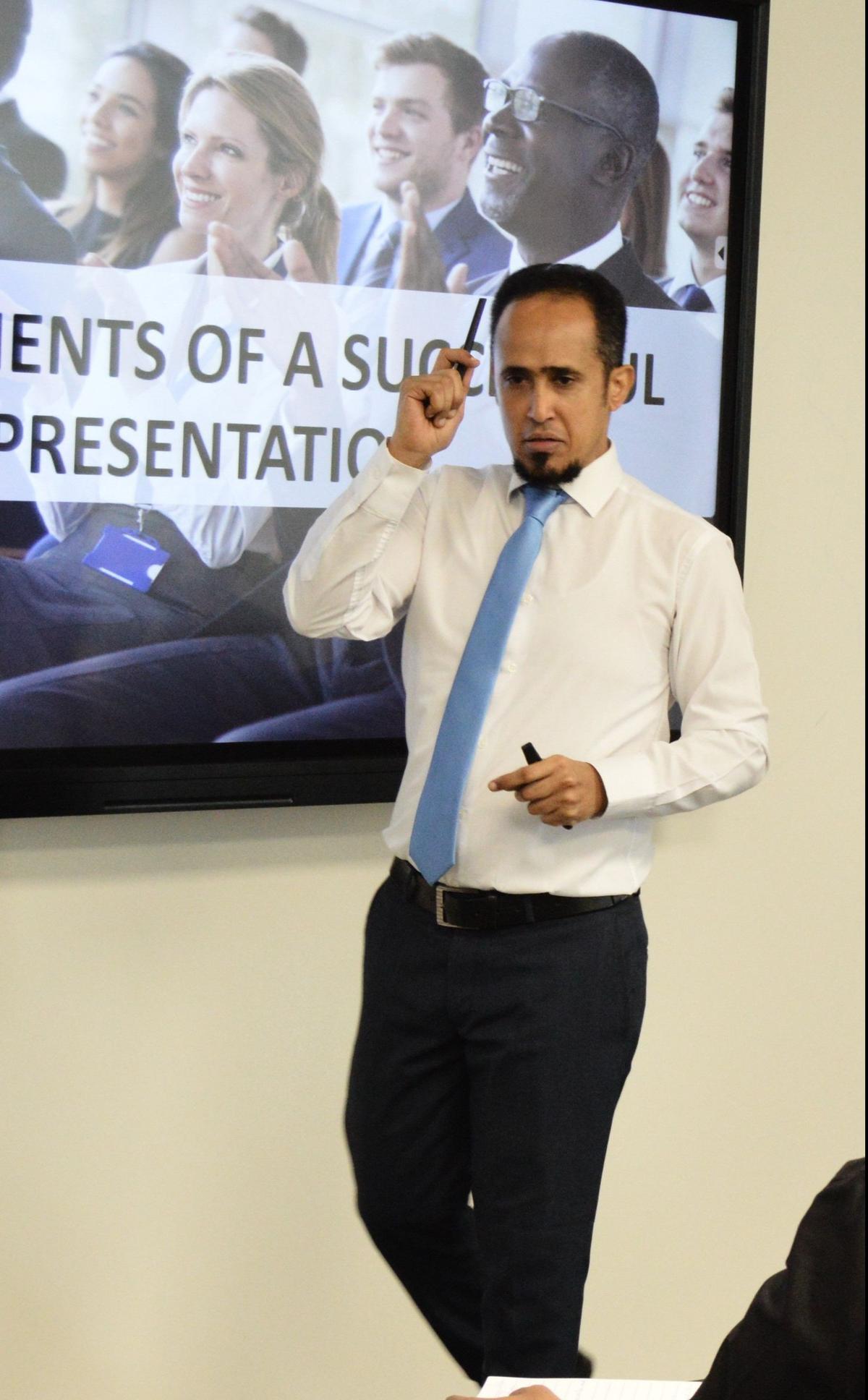
Tatek Abayneh Mebratu
Mr. Tatek is a Certified Trainer and Executive Coach with over 20 years of experience in the MENA region. He specializes in Leadership Development, Behavioral Training, and Talent Management, with deep expertise in Human Capital development.
With a career spanning over 15 years in training and consulting, Mr. Tatek has worked with senior executives and corporate teams to enhance business performance and employee engagement.
He holds a Bachelor of Arts in Public Administration and Development Management and has delivered training programs across all management levels. His work with KHDA and CPD further highlights his credibility in the field. Tatek has also held roles in the banking, consultancy, and learning and development sectors, including positions at Western Union and Quantum Consultancy. Currently, he serves as a Senior Corporate Training Manager at Learners Point Academy, Dubai.
Core Competencies:
- Strategising on training framework spanning need analysis, mapping training requirements, and delivery to develop an efficient workforce and motivated employees for maximum productivity in fast-growing organisations
- Measuring training effectiveness
- Create training policies, procedures, and metrics and ensure their alignment with organisational goals
- Innovative training and coaching techniques and delivery style
- Conducting TNA using the Stop/Start & Continue methods
Professional Qualifications:
- Certified Trainer (CPD) with expertise in Leadership Development, Behavioral Training, and Talent Management
- Certified in Coaching Skills for Leaders and Managers, Marketing and Communication, and Corporate and Strategic Communication Skills for Managers
- Certified in Investigative Journalism
- Master of Business Administration (MBA) in Marketing and Sales from Amity University
- Bachelor of Arts in Public Administration and Development Management from Alpha University College
- Over 20 years of experience in the MENA region, specializing in Human Capital development and corporate training
- Extensive experience in training programs across all management levels, including work with KHDA and CPD
- Proven track record in leadership roles within banking, consultancy, and learning and development sectors, including positions at Western Union and Quantum Consultancy
- Currently serving as Senior Corporate Training Manager at Learners Point Academy, Dubai
Learning Outcomes
When training is completed, you will master the following:
1
Connect CRM strategy to competitive advantage across B2B and B2C customer relationships
2
Identify customer perception points and service barriers that shape satisfaction and loyalty
3
Apply structured methods to manage queries, complaints and service recovery situations
4
Interpret customer feedback and Customer Lifetime Value to guide CRM decisions
5
Develop retention strategies that strengthen long-term customer loyalty and relationship value
6
Use CRM dashboards and technology to track and improve service performance

CPD Certification
Earn a globally recognized CPD UK Certification with professional credit points. This certificate can be attested by The UAE Ministry of Foreign Affairs and International Cooperation for UAE visa issuance.

KHDA Certificate
Earn a KHDA attested Course Certificate. The Knowledge and Human Development Authority (KHDA) is the educational quality assurance and regulatory authority of the Government of Dubai, United Arab Emirates.

Learners Point Certificate
Earn a Course Completion Certificate, an official Learners Point credential that confirms that you have successfully completed a course with us.

Overall ratings by our students
Related courses
Frequently asked questions
Our CRM course aims to give professionals the information and abilities they need to establish and preserve enduring bonds with customers. It covers topics like important methods, resources, and methods for efficiently handling consumer connections in order to increase client loyalty and satisfaction.
Our Customer Relationship Management course is ideal for professionals responsible for customer relationships, service quality, complaints, retention, or customer experience. It is particularly relevant for:
- Customer service and customer experience professionals
- Account and relationship managers
- Sales and client-facing professionals
- Team leaders and supervisors
- Professionals moving into customer-facing roles
We develop skills in CRM strategy, customer perception, complaint handling, service recovery, Customer Lifetime Value (CLV), customer feedback, and retention through practical activities and case-based learning.
Assessment is continuous and practical, rather than relying only on a final exam. Participants demonstrate their learning through:
- Role-plays and practical activities
- Case studies and workplace-based scenarios
- CRM strategy and measurement reviews
- Service recovery exercises
- A final comprehensive CRM assessment
Regular formative feedback helps participants improve throughout the program. A Learners Point certificate is awarded upon successful completion.
As every aspect of an organization considers customer satisfaction a crucial part of their business growth, customer service as an industry has emerged as one of the fastest-growing sectors over the decade. Due to the economic advancements in the nation, Dubai is attracting aspiring professionals. These growing trends contribute to the creation of new opportunities that are ever more critical raising the demand and competition for top talent in Dubai.
Dubai has abundant job opportunities for individuals who have a certification in Customer Relationship Management:
- CRM Specialist
- Sales Representative
- Customer Success Manager
- Marketing Specialist
- Business Analyst (CRM)
- Technical Support Specialist (CRM Systems)
- And many more …
The customer service field is a good career choice. Getting a customer relationship management certification can lead you down a variety of job roles in different industries that are in demand and rewarding. With a considerably higher projected job growth rate between 2020 and 2030, customer relationship management is a high-growth career field.
The course teaches participants how to use CRM dashboards, Customer Lifetime Value (CLV), customer feedback, and relationship indicators to support customer-focused decisions.
The CRM Measurement & Customer Insight Automation Sandbox allows participants to work with realistic customer information, feedback records, and service-performance data. They learn to identify customer trends, service barriers, perception points, and improvement opportunities.
The course combines CRM concepts with practical exercises designed around realistic customer situations. Participants complete:
- Customer relationship mapping
- Customer perception and CRM dashboard workshops
- Complaint handling and service recovery simulations
- Customer loyalty and retention strategy exercises
- Industry Simulation
- CRM Measurement & Customer Insight Automation Sandbox
These exercises help participants apply CRM measurement, customer feedback, service recovery, and retention principles to practical customer relationship challenges.
Learners Point has delivered professional training since 2001. Its Customer Relationship Management course is a 24-hour practical program focused on building measurable customer-facing capabilities.
The training uses Learners Point’s Friction Method™, which progresses through:
- Context and relevance
- Core concepts
- Practical application
- Challenging assumptions
- Targeted mentoring
- Refinement through practice
- Transfer of learning to day-to-day work
The program also combines case studies, simulations, practical assessments, and formative feedback rather than relying on one-way instruction.
Yes. Learners Point states that its training programs are designed to meet an organization’s real challenges rather than follow a generic curriculum.
A Training Needs Analysis (TNA) helps identify organizational requirements before training. This makes the learning experience more relevant, targeted, and applicable to participants’ work environments. The brochure also states that programs can be delivered on-site or online.
This course helps you build the practical CRM skills needed for a smooth career transition. You will learn customer relationship strategy, complaint handling, service recovery, CRM measurement, and retention through real-world exercises and simulations.
Do you want to learn more about Learners Point Academy?
- Learn more about courses
- Understand about our methodology
- Let’s talk about Corporate trainings
- Anything else that you want to know, we are here for you!