SPHRi Certification in Kuwait
35-hour SPHRi course across 10 modules
Globally recognised Senior HR certification
Advanced HR strategy planning with Copilot
Expert-led training with simulations & mock tests
Flexible learning options with easy instalments

 4.9/5
4.9/53379 EnrolledEnrolled Learners
4.9/53379 EnrolledEnrolled Learners
Overview
What we are going to teach you
- Master leadership through mergers, acquisitions, and human capital insights
- Build global HR strategies with compensation models & workforce planning
- Apply change management techniques to enhance organisational adaptability
- Use HR analytics tools to interpret metrics & improve decisions
- Advance careers with SPHRi Certification in international HR planning
- Strengthen talent management with learning initiatives & retention strategies
Upcoming sessions
Curriculum
- •Contribute to the development of the organizational strategy and planning (for example: vision, mission, values, ethical conduct, future business opportunities)
- •Develop, execute, and lead HR strategies that are aligned to the organisation’s strategic plan (for example: HR initiatives, plans, budgets, business plans, service delivery plans, workforce requirements)
- •Analyze and assess internal and external factors that impact operations and people management to decide on the best available risk management strategy (for example: human capital risk analysis, business continuity, response planning, geopolitical environment scanning, mental health)
- •Interpret and use business metrics to assess and drive achievement of strategic goals and objectives (for example: key performance indicators [KPIs], financial statements, budgets)
- •Use credible and relevant information to make decisions and recommendations (for example: salary data, management trends, published surveys and studies, legal/regulatory analysis)
- •Develop and manage workplace practices that are aligned with the organization’s vision, mission, values, sustainability, corporate social responsibility (CSR), ethics, and anti-corruption, to shape and reinforce organizational culture
- •Develop and evaluate strategies and workplace practices to promote diversity, equity, and inclusion (DEI)
- •Identify and analyze HR metrics to inform strategic actions within the organization (for example: develop new metrics, predictive analytics, business intelligence, turnover rates, cost per hire, employment statistics, return on investment [ROI], pay equity analysis)
- •Design, implement, and facilitate effective change strategies to align organizational performance with the organization’s strategic goals (for example: change leadership, change management)
- •Advise and influence organizational behavior and outcomes through effective relationships with key stakeholders
- •Ensure alignment of HR strategies across the organization (for example: across geographic locations/sites, across business units) ;
- •Apply and evaluate the applicability of local labor laws, regulations, and, guidance to organizational strategy/or complex HR strategies to adhere to legal and ethical requirements
- •Evaluate and forecast organizational needs throughout business cycles to develop or revise workforce plans (for example: corporate restructuring, divestitures, workforce expansion, or reduction)
- •Develop, monitor, and assess recruitment strategies to attract talent (for example: labor market analysis, salary expectations, selection processes, sourcing, employee value proposition [EVP] and employer branding)
- •Develop and evaluate strategies for onboarding new employees and managing cultural integrations (for example: new employee orientation, onboarding, restructuring, global expansion, mergers and acquisitions [M&A], joint ventures)
- •Evaluate the integration of diversity, equity, and inclusion (DEI) in the workplace culture and make recommendations based on findings
- •Design, implement, and evaluate programs or processes in order to develop the workforce (for example: training and development, knowledge management, mode, timing)
- •Analyze business needs to develop a succession plan for key roles (for example: identify talent, outline career progression, implement coaching and development) to promote business continuity
- •Design and evaluate strategies for employee engagement, satisfaction, and retention (for example: mentoring and sponsorship, flexible work arrangements)
- •Align team and individual performance goals to organizational measures of success
- •Design and evaluate strategies and processes for performance management (for example: performance evaluation, performance improvement, feedback, coaching)
- •Identify and implement strategies and processes for leadership development (for example: conflict resolution, mentoring, performance discussions, coaching, effective communication)
- •Develop and evaluate employee career and growth opportunities (for example: assessing talent, developing career paths, managing job movement within the organization)
- •Design policies and processes for the return of employees to the organization (for example: parental leave, expatriates returning to home country, employees returning from sabbaticals or layoffs)
- •Create and evaluate labor strategies (for example: collective bargaining, grievance program, strategic alignment with labor, other union-related activities)
- •Design and assess offboarding strategies, processes, and trends (for example: exit interviews, layoff strategies, alumni programs)
- •Design the total rewards philosophy and communications strategy that balances the organizational and individual needs (for example: hourly, salary, expatriate and foreign nationals, executives, board members, contractors)
- •Create and evaluate compensation strategies that attract, reward, and retain talent (for example: classification, direct, indirect, incentives, bonuses, equity, executive compensation) ;
- •Create and evaluate benefit strategies that attract, reward, and retain talent (for example: health, welfare, retirement, work-life balance, wellness)
- •Design and develop employee recognition programs (for example: non-monetary and monetary rewards, workplace amenities, service awards)
- •Align HR data privacy and security processes to organizational data protection strategies (for example: cyber security, phishing emails, documentation, employee files)
- •Evaluate employee safety and security strategies (for example: emergency response plans, access control, contingency planning, crisis management)
- •Lead, implement, and evaluate HR digitalization initiatives (for example: information, workflows, emerging technologies, gamification, employee self-service, social networking, and human resource information system [HRIS], risk management system)
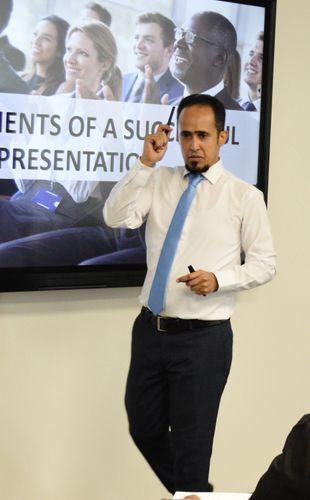
Meet your Trainer
Ashraf Shawky
Ashraf Shawky is a seasoned training professional with over 15 years of experience in the UAE and MENA region. He began his career with the Oberoi Group in Egypt and later worked at Americana as a Training and Development Manager. He also served as Senior HR Manager for Emirates Flight Catering and HR & Development Manager for Faisal Jassim Group.
Ashraf has delivered a wide range of training programs, including HR, leadership, and soft skills topics like Entrepreneurship, Leadership, HR Administration, and Strategic Management. He has conducted workshops for prominent organizations such as Emirates Foundation, Jumeirah Group, and ADNEC. His industry expertise enables him to provide practical, engaging learning experiences, particularly for UAE Nationals.
Core Competencies:
- Human Resources (HR)
- Compensation & Benefits
- Leadership Development
- Supply Chain Management
- Quality Management
- Employee Relations
- Performance Management
- Talent Management
Professional Qualifications:
- Training and Development Manager - Americana
- Senior HR Manager - Emirates Flight Catering
- HR & Development Manager - Faisal Jassim Group
- Trainer - Emirates Foundation, Jumeirah Group, ADNEC

Meet your Trainer
Ms. Marichu Sarabia
Ms. Marichu stands out as a distinguished corporate trainer, specializing in the Human Resources domain. Her illustrious career spans 6 years in the training industry, complemented by an impressive 13-year tenure as the Head of Human Resources. Throughout her extensive 19-year professional journey, Ms. Marichu has held key roles in Operations, Document Control, and various other capacities, amassing a wealth of expertise.
Apart from her multifaceted career, Ms. Marichu is recognized for her prowess in conducting personality development and other soft skills courses. She has orchestrated numerous successful Human Resources workshops and programs tailored for corporate delegates, aiding them in achieving professional excellence. Ms. Marichu's teaching philosophy goes beyond imparting skills; she believes in inspiring and motivating learners to reach their goals.
Ms. Marichu's commitment to empowering individuals for success is evident in the achievements of her students, a testament to her dedication and impact in the realm of corporate training. Her unique teaching style has garnered appreciation globally, with students attesting to the effectiveness of her approach.
Core Competencies:
- Credit Control
- Document Control
- Public SpeakingCommunication Skills
- Certified Training Manager
- Train the Trainer
- Problem-solving and Decision Making
- Certified Strategic Manager
- Executive Secretarial Management
Professional Qualifications:
- Certificate of Completion Public Speaking Technical Training (2021)
- Certificate of Completion for Personal Development and Self-Awareness (2020)
- Certificate of UAE Labor Law Training (2019)
- Certified Train the Trainer (2018)
- Certified PECB ISO Certification Invigilator(2016)
Learning Outcomes
After completion of the training, you will master the following:
1
Master change management techniques to improve organisational adaptability & growth
2
Implement employee performance systems to measure productivity & business outcomes
3
Apply global HR practices to align policies across diverse international environments
4
Use human capital analysis for data-driven workforce planning & strategy
5
Develop leadership applications to guide HR strategy at senior levels

KHDA Certificate
Earn a KHDA attested Course Certificate. The Knowledge and Human Development Authority (KHDA) is the educational quality assurance and regulatory authority of the Government of Dubai, United Arab Emirates.

Learners Point Certificate
Earn a Course Completion Certificate, an official Learners Point credential that confirms that you have successfully completed a course with us.

Prerequisites
- Minimum 4 years of professional experience in an HR position and a master’s degree or global equivalent, OR
- At least 5 years of work experience in an HR position and a bachelor’s degree or global equivalent, OR
- Minimum 7 years of experience in a professional-level HR position
Overall ratings by our students
Related courses
Frequently asked questions
The SPHRi Certification in Kuwait is all about preparing senior HR professionals to design policies and strategies better. This covers business management, HR development, workforce planning, compensation, benefits, and global HR practices. The course also helps professionals to prepare for the SPHRi exam. You build the skills to manage international HR challenges and support business growth.
Professionals with this training are eligible to apply for high-level HR positions across industries, like -
- HR Director
- Senior HR Manager
- HR Consultant
- Vice President of Human Resources
- HR Business Partner
- Chief Human Resources Officer(CHRO)
The major topics covered in this training include -
- Leadership and Strategy
- Workforce Planning and Talent Acquisition
- Talent Management
- Total Rewards
- HR Information Management, Safety, and Security
The SPHRi Certification exam consists of 115 scored MCQs and 25 pretest questions. The exam duration is 2 hours and 45 minutes, with an additional 30 minutes for administration. Questions test your knowledge across areas like leadership, talent management, HR service delivery, and measurement and analysis.
Our SPHRi course teaches professionals ways to track HR and business metrics and interpret data. You also learn to use these insights to improve employee performance and enhance the overall productivity of the organisation.
Do you want to learn more about Learners Point Academy?
- Learn more about courses
- Understand about our methodology
- Let’s talk about Corporate trainings
- Anything else that you want to know, we are here for you!