Leadership and Team Building Training in Oman
Program aligned with KSA Vision 2030 and UAE Vision 2031
24 hour training with 10 modules
Build high-trust team dynamics and improve cross-functional teamwork
Reduce workplace friction with constructive conversations
Measurable business impact focus with better RoIs
Practice real leadership scenarios in Automation Sandbox with AI support tools

 4.75/5
4300 EnrolledEnrolled Learners
4.75/54300 EnrolledEnrolled Learners
Overview
What we will be covering:
- Develop ability to communicate effectively and honestly
- Understand the different leadership styles
- Our course looks at motivational strategies to inspire teams
- Learn AI-driven team strategies using Microsoft Copilot and Automation Sandbox
- Boost delegating skills & foster an environment of cooperation between groups
- Analyse several approaches to dispute and conflict settlement
- Practical and hands-on education
- Establish collaboration, trust, and teamwork to create productive team dynamics
Upcoming sessions
Curriculum
1
What is a team?
2
Factors needed for success
3
Characteristics of a high-performance team
4
Different types of teams
5
Core teambuilding competencies
6
Skill Mapping: Identifies team strengths and capability gaps efficiently
7
Collaboration Insights: Uses AI tools to assess group performance dynamics
8
Role Alignment: Supports balanced task distribution through data-driven analysis
9
Human Oversight: Applies judgment for culturally aligned role assignments
10
Team Identity: Preserves human connection beyond algorithmic recommendations
1
Role of a leader in a team’s success
2
Characteristics of an effective leader
3
The emotional requirements of being a leader
4
Establishing confidence and trust with employees
5
Dealing with different personalities
6
Using ‘common sense’ motivating factors
7
The four leadership styles
8
Style Evaluation: Analyzes leadership behaviors through AI-driven diagnostics
9
Engagement Feedback: Provides actionable insights to enhance team motivation
10
Personality Mapping: Identifies traits influencing collaboration and decision-making
11
Emotional Intelligence: Balances analytical insight with authentic human connection
12
Trust Building: Recognizes when AI feedback lacks depth or empathy
1
Stages of team development: Forming, Norming, Performing, Adjourning
2
Employee development
3
Recognizing your role in motivating your team
4
Understanding motivation
5
Personality profiling
6
KPI Monitoring: Tracks performance metrics with precision and consistency
7
Engagement Analysis: Measures team participation and morale through AI insights
8
Attrition Prediction: Identifies early patterns signaling potential turnover risks
9
Productivity Insights: Highlights progress while supporting motivational leadership
10
Human-Centered Focus: Detects when feedback lacks personal or emotional context
1
Talk straight
2
Demonstrate respect
3
Create transparency
4
Right wrongs
5
Show loyalty
6
Deliver results
7
Get better
8
Confront reality
9
Clarify expectation
10
Clarity Analysis: Scans messages for tone, coherence, and transparency
11
Feedback Insights: Provides actionable input on communication consistency and tone
12
Accountability Tracking: Detects gaps in responsibility and message alignment
13
Human Judgment: Recognizes when AI overlooks emotional or intent-based nuances
14
Authentic Connection: Reinforces loyalty and respect through genuine human interaction
1
Practice accountability
2
Listen first
3
Keep commitments
4
Extend trust
5
Project Tracking: Uses AI tools to monitor tasks and progress trends
6
Data Insights: Highlights patterns in deliverables, timelines, and performance metrics
7
Trust Integration: Balances analytics with personal, trust-based leadership engagement
8
Listening Awareness: Identifies when AI feedback replaces genuine human attention
9
Empathy Emphasis: Ensures every team member feels heard beyond data reports
1
What is conflict?
2
Conflict versus problem
3
Level of conflict
4
Conflict management styles
5
Conflict resolution
6
Sentiment Monitoring: Tracks team communication to identify early conflict signals
7
Alert Systems: Uses AI insights for proactive conflict management strategies
8
Empathetic Leadership: Balances AI detection with personal, human-driven resolution
9
Context Awareness: Recognizes when AI overlooks cultural or emotional nuances
10
Human Mediation: Reinforces the irreplaceable role of empathy in conflict resolution
1
The six thinking hats
2
Encouraging brainstorming
3
Building consensus
4
Idea Generation: Uses AI prompts to inspire innovative problem-solving approaches
5
Scenario Simulation: Models decision outcomes for data-backed strategic insights
6
Team Empowerment: Encourages human consensus in final decision-making processes
7
Balance Awareness: Identifies over-reliance that weakens team engagement and ownership
8
Creative Integrity: Ensures AI supports rather than replaces collaborative judgment
1
The benefits and disadvantages
2
Teambuilding activities that won’t make people cringe
3
Choosing a location for teambuilding
4
Activity Planning: Uses AI insights to suggest effective engagement formats
5
Participation Analysis: Evaluates team interaction and activity impact in real time
6
Context Alignment: Encourages customization based on unique team culture and needs
7
Human Oversight: Maintains facilitator judgment in designing authentic experiences
8
Engagement Authenticity: Identifies when automation reduces energy and team connection
Phase 1 – Task & Workflow Design:
Break team functions into planning, communication, monitoring, and engagement. Assign AI agents to tasks like deliverable tracking, sentiment analysis, and brainstorming prompts. Keep humans responsible for trust, empathy, and final decision-making.
Phase 2 – Strategic Implementation Choices:
Implement AI in team monitoring, skill matching, and idea generation. Retain human roles in trust-building, motivation, and conflict resolution.
Phase 3 – Productivity vs. Risk Analysis:
Quantify time saved, idea generation, and accountability tracking. Assess risks like over-reliance or loss of trust. Build frameworks that balance automation with human leadership.
Meet your Trainer
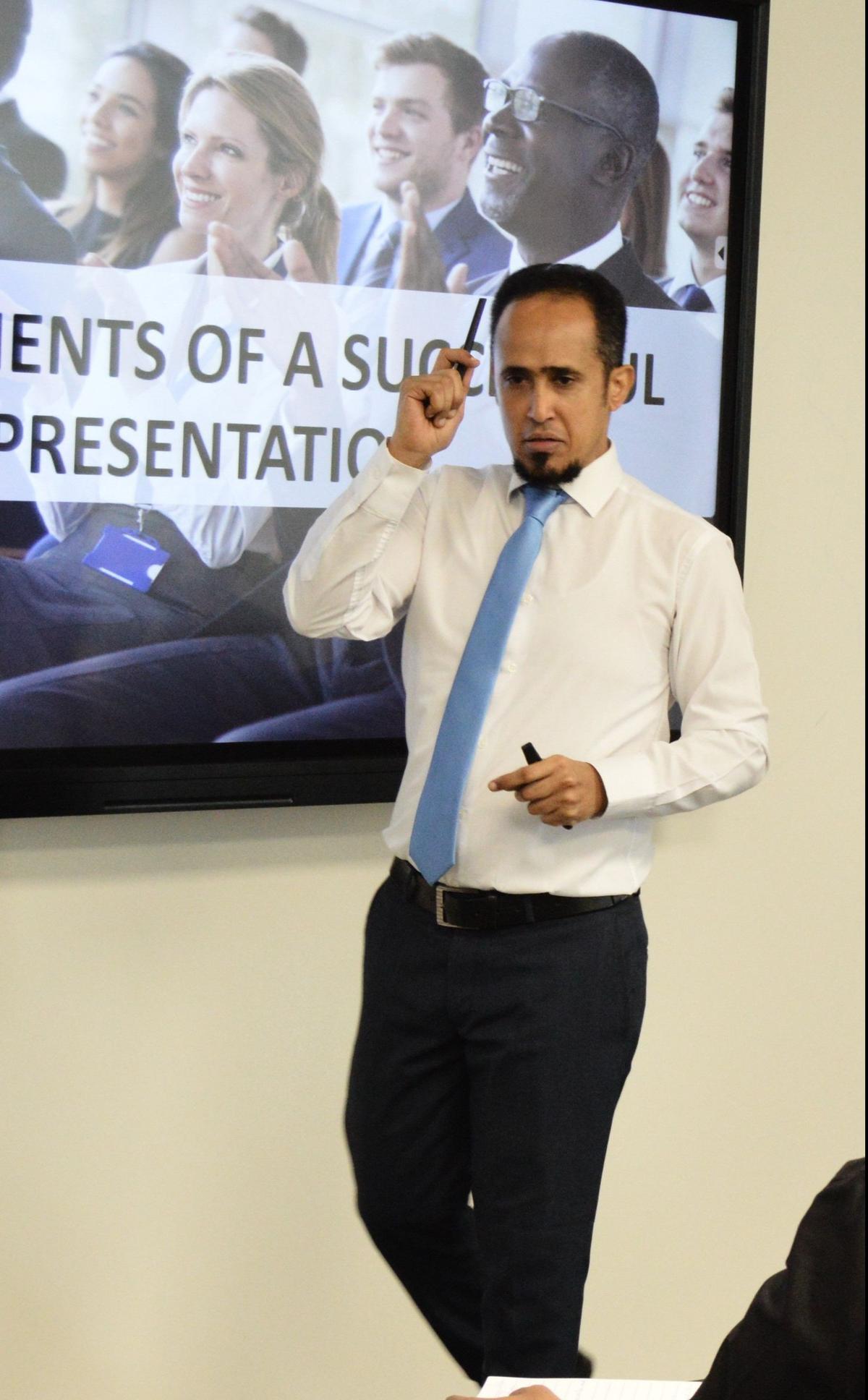
Tatek Abayneh Mebratu
Mr. Tatek is a Certified Trainer and Executive Coach with over 20 years of experience in the MENA region. He specializes in Leadership Development, Behavioral Training, and Talent Management, with deep expertise in Human Capital development.
With a career spanning over 15 years in training and consulting, Mr. Tatek has worked with senior executives and corporate teams to enhance business performance and employee engagement.
He holds a Bachelor of Arts in Public Administration and Development Management and has delivered training programs across all management levels. His work with KHDA and CPD further highlights his credibility in the field. Tatek has also held roles in the banking, consultancy, and learning and development sectors, including positions at Western Union and Quantum Consultancy. Currently, he serves as a Senior Corporate Training Manager at Learners Point Academy, Dubai.
Core Competencies:
- Strategising on training framework spanning need analysis, mapping training requirements, and delivery to develop an efficient workforce and motivated employees for maximum productivity in fast-growing organisations
- Measuring training effectiveness
- Create training policies, procedures, and metrics and ensure their alignment with organisational goals
- Innovative training and coaching techniques and delivery style
- Conducting TNA using the Stop/Start & Continue methods
Professional Qualifications:
- Certified Trainer (CPD) with expertise in Leadership Development, Behavioral Training, and Talent Management
- Certified in Coaching Skills for Leaders and Managers, Marketing and Communication, and Corporate and Strategic Communication Skills for Managers
- Certified in Investigative Journalism
- Master of Business Administration (MBA) in Marketing and Sales from Amity University
- Bachelor of Arts in Public Administration and Development Management from Alpha University College
- Over 20 years of experience in the MENA region, specializing in Human Capital development and corporate training
- Extensive experience in training programs across all management levels, including work with KHDA and CPD
- Proven track record in leadership roles within banking, consultancy, and learning and development sectors, including positions at Western Union and Quantum Consultancy
- Currently serving as Senior Corporate Training Manager at Learners Point Academy, Dubai
Meet your Trainer
Neena
Neena is dedicated to motivating and empowering individuals from various backgrounds. She has coached over 500 students and professionals in life and professional skills. Neena possesses strong communication, collaboration and motivation abilities, adept at imparting knowledge effectively.
Neena excels in using educational methods to design and deliver effective training programs, both onsite and virtual, integrating instructional technology. This has ensured she remains updated with the latest methodologies and insights to enhance learning experiences.
Neena has a knack for grasping new concepts and applying them productively. She fosters an environment that promotes growth and skill development for her students and clients.
Core Competencies:
- Corporate training for small and large groups
- Expertise in HR and behavioral skills
- Life skills coaching and leadership development
- Soft skills and personality development training
- Talent acquisition and performance management
- Team-building and supervisory skills development
- Presentation, public speaking, and coaching
- Interview skills and workforce planning
- Learning management systems and instructional technology
- Certified in EI, MBTI, and psychometrics
Professional Qualifications:
- MBA from Loyola College
- CHRM, CHRP, NLP, TQM certified
- Certified Talent Acquisition Specialist (CTAS)
- PhD in Psychology & Philosophy (pursuing)
- Corporate Trainer since 2018
- Trainer for multiple global organizations
- Expertise in HR, coaching, and leadership
- Experience with diverse industries and sectors

Learning Outcomes
By course's end, you will master:
1
Recognise and understand the various forms and structures of teams
2
Know the qualities that make a team effective
3
Make use of individual abilities to improve the dynamics of the team as a whole
4
Determine and recognise the essential components that propel the group ahead
5
Master problem-solving skills
6
Learn how to inspire the team by arranging several team-building activities

KHDA Certificate
Earn a KHDA attested Course Certificate. The Knowledge and Human Development Authority (KHDA) is the educational quality assurance and regulatory authority of the Government of Dubai, United Arab Emirates.

Learners Point Certificate
Earn a Course Completion Certificate, an official Learners Point credential that confirms that you have successfully completed a course with us.

Overall ratings by our students
Related courses
Frequently asked questions
The Leadership and Team-Building Training in Oman is designed to help professionals strengthen core leadership abilities such as building trust, motivating teams, communicating effectively and implementing action plans. The program focuses on practical strategies that enable participants to lead confidently and navigate different workplace personalities.
This training also prepares learners to handle real organisational challenges through interactive activities, case studies and structured team-building exercises. Whether you are an emerging leader or an experienced professional, this course helps to create productive, collaborative and high-performing teams in Oman’s evolving work environment.
The Leadership and Team-Building Training in Oman is ideal for aspiring leaders, managers, department heads, entrepreneurs and anyone who wants to build leadership skills to manage teams effectively.
The Sandbox lets you apply different leadership styles, directive, supportive, coaching and delegating, across simulated team environments. It then uses AI insights to show the strengths and weaknesses of each approach.
By seeing how teams respond to your choices, you gradually learn when to shift your leadership style to improve collaboration, accountability and trust in real-world settings.
AI-powered tools evaluate clarity, tone, and structure in your communication, giving you detailed feedback. This include:
1. Identifies unclear instructions
2. Flags overly complex phrasing
3. Tracks response patterns
4. Suggests clarity improvements
5. Supports transparent communication habits
With the Leadership and Team-Building Training in Oman, you can develop the following skills:
1) Teamwork
2) Communication
3) Adaptability
4) Problem-solving
5) Decision making
6) Emotional Intelligence
Learners Point offers 3 types of classes for the Leadership and Team-Building Training in Oman. Students can choose between one of the following:
1) One-on-one training sessions
2) Instructor-led classroom-based group coaching
3) High-quality live and interactive online sessions
At Learners Point, if a participant doesn’t wish to proceed with the Leadership and Team-Building Training in Oman after the registration due to any reason, he or she is eligible for a 100% refund. However, the refund will be issued only if we are notified in writing within 2 days from the registration date. The refund will be processed within 4 weeks from the day of exit.
Do you want to learn more about Learners Point Academy?
- Learn more about courses
- Understand about our methodology
- Let’s talk about Corporate trainings
- Anything else that you want to know, we are here for you!